Monday, March 31, 2014

Geometry in Action


My dad recently asked me what would be larger: a circle in which you increase the circumference by 2, or a circle in which you increase the radius by two. Using a few formulas (C=2πr; A=πr^2), it became apparent that the circle in which you increase the radius by two is considerably larger. I was able to illustrate this in GSP so you could get a dramatic visual of the question. (TF-2)

Saturday, March 29, 2014

Circles in Mega Man II

Mega Man.png


Whilst playing Mega Man II, I unfortunately died. More or less, this is how I looked right before I did die:
Mega Man Expression.png 


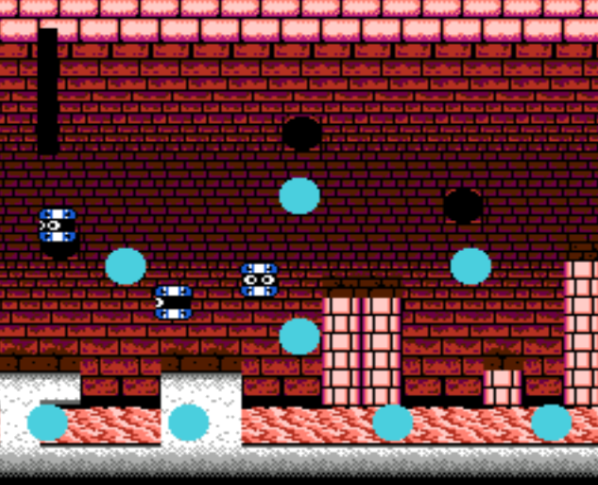
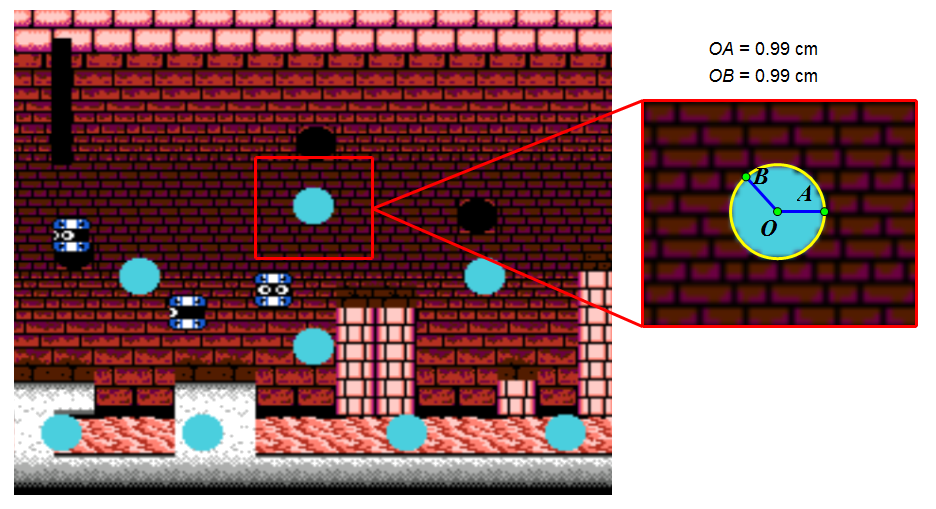
All silliness aside, I did notice that Mega Man explodes into a bunch of circles upon death.

Mega Man Circle Proof.png

The circles Mega Man explodes into when he dies share all of the qualities of circles and can be used to demonstrate them:

Mega Man Circle Chords.png


For example, these circles can be used to demonstrate Theorem 9-11, which states “when two chords intersect inside a circle, the product of the segments of one chord equals the product of the segments of the other chord.” As shown by my diagram, AX * BX =CX * DX, which is exactly what the theorem states. (~JC1)

And no, Channing, Air Man (pictured below) is not wearing some kind of fancy pants.

Air Man.png

Pizza with Similar Triangles

This is a picture of a pizza slice wrapped in aluminum foil. Although it may be hard to see, the foil is folded in such a way that the edge is parallel to the opposite edge of the pizza, therefore forming two triangles. These two triangles are similar.


Guide:
A=point to the lower left
B=point farthest to the top
C=point farthest to the right
D=point on line AB
E=point on line AC

Proof:

Statements:                                  Reasons:
1. m<A=m<A                              1. Reflexive Property
2. Line DE and line BC are ||.      2. Given
3. m<ADE=m<ABC                    3. If two parallel lines are cut by a transversal, then corresponding                                                          angles are congruent.
4. Triangle ABC is congruent     4. AA Postulate
to triangle ADE.

Instead of using <ADE and <ABC, I also could have used <AED and <ACB. Both would fulfill the criteria of using the AA Postulate, that two angles from each triangle must be congruent for the triangles to be proved similar. (~RG1)

Great Tasting Geometry


Over the weekend, I went to my favorite restaurant in Santa Cruz called Tramonti's. I ordered my favorite pizza with ham, mushrooms, and a huge egg on top, and I couldn't resist making a collage of it to show geometric similarities! On the far right of the picture, I have half of the pizza, or a semi-circle equaling 180 degrees. I showed the Arc Addition Postulate because arc ADB plus arc BED is equal to the total of arc ABC. In the top left hand corner of the picture, I proved Theorem 9-3. I showed that the minor arcs FG and HG were congruent because their central angles were congruent. I also was able to prove Theorem 9-5 in the same picture. Diameter FH is perpendicular to chord JK so it bisected the chord and its arc. In the bottom left hand corner, I am just showing that the pizza slice made an isosceles triangle with MN congruent to OM. This pizza was not only delicious, it was full of geometry! (~MG1)

Parallel Yardlines

ABC = 155
DCB = 25

This is an example of parallel lines by Theorem 3-6, which says that if two lines are cut by a transversal and the same-side interior angles are supplementary then the lines are parallel. (~CB)


(CB per 5)

Thursday, March 27, 2014

Regular Octogan


When I was at a hotel recently, I noticed that the table was a regular octagon. Because this picture was taken at a distance, the table is distorted. From straight on top the table would look more like this.

I wanted to find the area of the octagon.  The equation for this is (1/2)(apothem)(perimeter).  The apothem is the length from the center to the midpoint of one of the sides.

Here, segment OI is the apothem and is 4.35 cm.  Each side is 3.61 cm. The real table's sides were about 0.6m or 60cm. To find the real apothem we can set up a proportion with


This equals 72.299cm, the length of the apothem.  Then, we can find the area of the octogon


(~NW5)

Sunday, March 23, 2014

Pi(e) Day

On Pi Day, I was very disappointed when we didn't eat pie. But then we started to talk about finding circumferences using pi, and in that moment I knew that was my mission...or at least an idea for a post. Using a real pie, I can demonstrate the function of pi to find the circumference of said pie and see if the ratio is correct. (~CB1)