
Showing posts with label angles. Show all posts
Showing posts with label angles. Show all posts
Friday, May 2, 2014
Congruent Segments and Arcs

Almost Parallel...

Over spring break I got to go to Mexico and see some amazing sunsets. When I was looking back on the pictures of my vacation and found this, I noticed that the point where the sand and the water come together looked almost parallel to the horizon line. If two lines are cut by a transversal and the alternate interior angles are congruent, then the lines are parallel. When I measured out the angles, I found that they were very close but not completely congruent. So although it looks parallel just by looking at it, it's not quite. (~JC2)
Sunday, April 20, 2014
Weave of a Rattan Chair


Wednesday, April 2, 2014
Angles and Arcs in Clocks

In this picture angle EJF equals 135.15 and is congruent to its arc EF which equals 135.19. This is because a central angle inscribed in a circle is congruent to its arc.
[Note: The numbers are slightly off though because the angle is not exactly in the center of the clock. This makes the numbers not perfectly equal but if the angle was in the center the angle and the arc would be congruent.]
(~AD1)
Proving Theorem 9-5 with a Car Tire
As theorem 9-5 states, "a diameter that is perpendicular to a chord bisects the chord and its arc." I decided to use a picture of my car tire to show the proof of this theorem.


Tuesday, April 1, 2014
Arcs and Central Angles
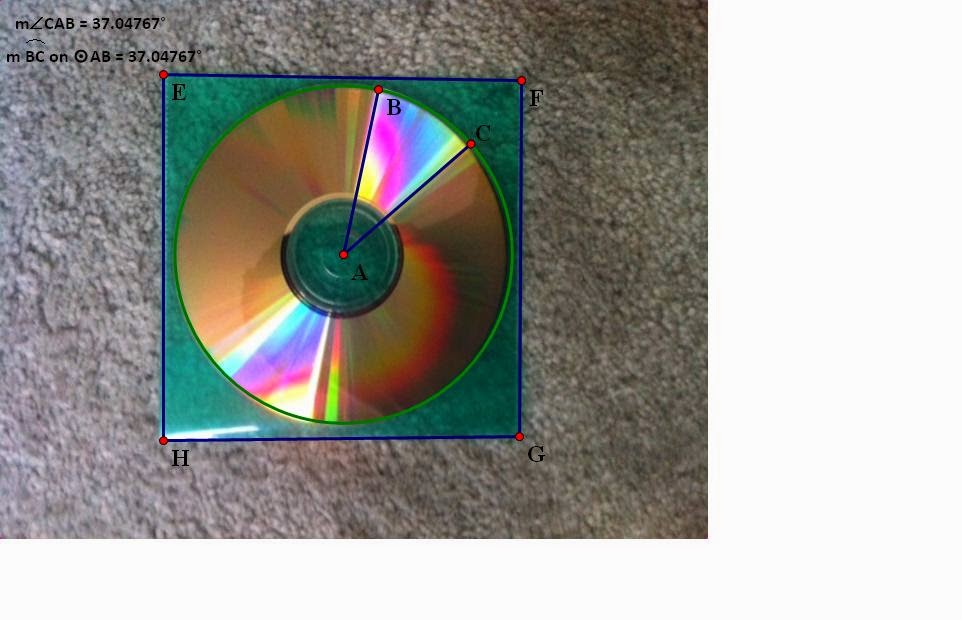
This picture is of a CD disk in its cover. This picture shows two different ideas. One idea is a quadrilateral circumscribed about a circle. The cover fits around the disk like a quadrilateral circumscribed about a circle. The second idea is arcs and central angles. Point A is the center point here. Arc BC is approximately 37 degrees. The central angle CAB is also 37 degrees.
Inscribed Angles and Three Corollaries
Corollary 1: If two inscribed angles intercept the same arc, then the angles are congruent.

Corollary 2: An angle inscribed in a semicircle is a right angle.

And finally,
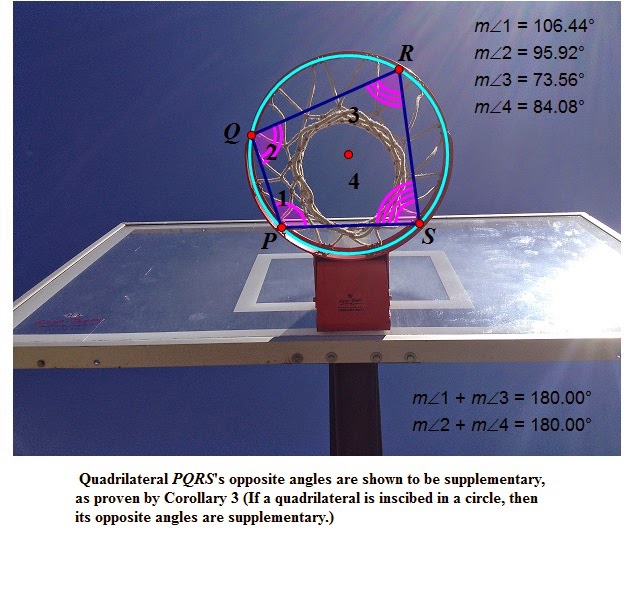
Corollary 3: If a quadrilateral is inscribed in a circle, then its opposite angles are supplementary.
(~RO5)
The Circular Olive

"If a quadrilateral is inscribed in a circle, then its opposite angles are supplementary."
This corollary is clearly proven through the addition of the opposite angles of the quadrilateral I drew within this circle on GSP. (~AI5)
Angles on a Clock

When I was looking at my clock I noticed that not only could I find the angles made by radii of the triangles but also secants using the theorems in chapter 9. By theorem 9-4 I determined that the measure of angle BCD was equal to the measure of arc BD. From that I was able to use theorem 9-7 to prove the measure of angle BAD is equal to half of arc BD. Therefore the measure of angle BAD is equal to half of the measure of angle BCD. (~AL1)
GIRL

At my local swimming pool, I found a women's bathroom sign with the shape of a perfect circle and was wondering if I could prove any geometric theorems with it.

On Geometer's Sketchpad, I drew a tangent of the circle and a secant to the circle. I planned to prove theorem 9-10 which states that two secants, two tangents, or a secant and a tangent follow the same equation. The angle that is formed by the intersecting lines would be equivalent to 1/2 the quantity of the major arch created minus the minor arch created.

Through GSP, I have proven that no matter what size or angle, the equation works every time.

(~WM5)
Saturday, March 29, 2014
Great Tasting Geometry

Over the weekend, I went to my favorite restaurant in Santa Cruz called Tramonti's. I ordered my favorite pizza with ham, mushrooms, and a huge egg on top, and I couldn't resist making a collage of it to show geometric similarities! On the far right of the picture, I have half of the pizza, or a semi-circle equaling 180 degrees. I showed the Arc Addition Postulate because arc ADB plus arc BED is equal to the total of arc ABC. In the top left hand corner of the picture, I proved Theorem 9-3. I showed that the minor arcs FG and HG were congruent because their central angles were congruent. I also was able to prove Theorem 9-5 in the same picture. Diameter FH is perpendicular to chord JK so it bisected the chord and its arc. In the bottom left hand corner, I am just showing that the pizza slice made an isosceles triangle with MN congruent to OM. This pizza was not only delicious, it was full of geometry! (~MG1)
Parallel Yardlines

ABC = 155
DCB = 25
This is an example of parallel lines by Theorem 3-6, which says that if two lines are cut by a transversal and the same-side interior angles are supplementary then the lines are parallel. (~CB)
(CB per 5)
Thursday, March 27, 2014
Regular Octogan

When I was at a hotel recently, I noticed that the table was a regular octagon. Because this picture was taken at a distance, the table is distorted. From straight on top the table would look more like this.


This equals 72.299cm, the length of the apothem. Then, we can find the area of the octogon

(~NW5)
Wednesday, March 12, 2014
Dining Table
This is a picture of my dining table. I wanted to see how parallel the different planks were on the table. I decided to use the corresponding angle postulate and I got these angles. They aren't quite parallel but are very close. (~TR1)

Chocolates!
This is a picture of a Nestle chocolate tin container I saw at my friend's house. This demonstrates the theorem stating, "The sum of the measures of the angles of a convex polygon with n sides is (n-2)180." The chocolate tin was in the shape of an octagon, which obviously has eight sides. So the sum of the measures of the interior angles of this polygon is (8-6)180=1080 degrees. Each individual angle was 135 degrees, and 135(8)=1080. Yay! (~RG1)

Tuesday, March 11, 2014
Mario's Parallel Coins
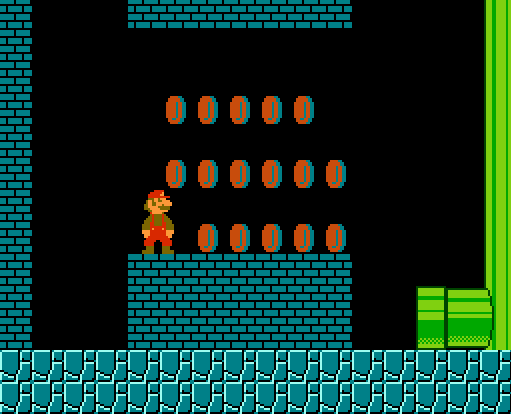
While playing a computer version of the classic Super Mario Bros. that I found online, I found a secret underground area, which is pictured above. In the underground area, I noticed that the coins seemed to be perfectly parallel to each other.
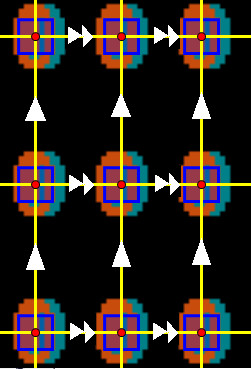
And, as it turned out, I was correct. By placing a point at the center of each coin and drawing lines between them, the coins formed lines parallel vertical lines and parallel horizontal lines. One can prove them parallel because the corresponding angles are congruent, the alternate interior angles are congruent, and the same-side interior angles are congruent. Because all of the angles formed by the intersections of the vertical and horizontal lines all have a measure of 90 degrees, they are perpendicular. This shows something important about coplanar horizontal and vertical lines: they are always perpendicular to each other. (~JC1)
Quilting Stars


Geometric Window

This is a picture I took of my garage window. I noticed more than one geometry concept in it. It is an example of parallel lines, congruent angles, and perpendicular lines. I compared the lengths of each segment with the length of my phone and they are indeed equal. -(CD1)
Geometric Sydney

While I was visiting Australia over February break with my mom, I took a head on picture of the Sydney Opera House from a ferry I was on. From this picture, you can see the demonstration of Theorem 4-7, which states - "If a point lies on the bisector of an angle, then the point is equidistant from the sides of the angle. The solid green line down the center is the angle bisector, as the other two green lines on the sides are the sides of the angle, which is 91.84 degrees. It then split the angle into two smaller angles of 45.92 degrees each. I then constructed a point on the line and connected it to the two sides, showing that they are each the same distance, 2.39 cm. (~JG2)
The Interior Angle Equation of a Polygon
Here is an example of how the equation used to find the interior angle measure sum in polygons works.
Angle sum = (n-2)(180)

This is a Lamborghini that I photographed at a car show. Notice how the headlights form pentagons. Now we will test to see if the equation works.
To find the sum of the interior angles in a pentagon, the equation is (5-2)(180).
(5 - 2)(180)
= 3(180)
= 540
So, the total measure of all the angles in a pentagon equals 540 degrees. This equation should work for all pentagons, so now let's test to see if it works on the headlight.

As we can see, the measures of all the angles are: 54.56, 129.09, 103.2, 136.76, and 116.39. If we add these all together, we get 540, which proves the equation to be correct, for both regular and non-regular polygons. (~DM5)
Angle sum = (n-2)(180)
To find the sum of the interior angles in a pentagon, the equation is (5-2)(180).
(5 - 2)(180)
= 3(180)
= 540
So, the total measure of all the angles in a pentagon equals 540 degrees. This equation should work for all pentagons, so now let's test to see if it works on the headlight.
Subscribe to:
Posts (Atom)