Showing posts with label parallel. Show all posts

Tuesday, May 13, 2014

Proof of Parallels

My brother recently had surgery and will be restricted to a wheelchair for the next six weeks. Because of this, we need wheelchair ramps on our steps so he has access to the house. The wheels on a wheelchair are parallel, so the ramps must be parallel or the wheelchair cannot successfully scale the ramps. I can prove that the wheels are parallel, and that the ramps are close enough to parallel to allow the wheelchair to travel up and down them.


Because of the angle at which the pictures were taken, the ramps appear slightly crooked, but I can assure you that they are not. If you zoom out, you can see this.


(~CB1)

Friday, May 2, 2014

Almost Parallel...


Over spring break I got to go to Mexico and see some amazing sunsets. When I was looking back on the pictures of my vacation and found this, I noticed that the point where the sand and the water come together looked almost parallel to the horizon line. If two lines are cut by a transversal and the alternate interior angles are congruent, then the lines are parallel. When I measured out the angles, I found that they were very close but not completely congruent. So although it looks parallel just by looking at it, it's not quite. (~JC2)

Saturday, March 29, 2014

Parallel Yardlines

ABC = 155
DCB = 25

This is an example of parallel lines by Theorem 3-6, which says that if two lines are cut by a transversal and the same-side interior angles are supplementary then the lines are parallel. (~CB)


(CB per 5)

Thursday, March 13, 2014

Parallel or Not?


These are bricks arranged in a pattern to create the back walls of a fireplace. I wanted to see if the lines were exactly parallel. However, the alternate interior angles are not congruent, meaning that according to my GSP diagram, the edges of the brick are not congruent. Also notice that to make this pattern, the bricks have to be exactly 2x longer than they are wide... (TF2)

Wednesday, March 12, 2014

Dining Table

This is a picture of my dining table. I wanted to see how parallel the different planks were on the table. I decided to use the corresponding angle postulate and I got these angles. They aren't quite parallel but are very close. (~TR1)


The Television: Two Rectangles

This is picture of my TV at home. There is the screen, the first rectangle, and the frame, the second rectangle. In real life, the four pairs of sides of the rectangles are parallel. Also, one characteristic of rectangles is that all of their included angles are right angles, as shown in the image. (~RG1)


Similar Triangles with Parallel Sides

 
While listening to music, I noticed that the logo on my headphones is an example of two similar triangles. To prove this, I traced both triangles, and then found the midpoints of lines AC and BC. These two points happened to land precisely where expected, and so I connected them to form a white overlay of the symbol.

I used the measuring tool in GSP to find all five angles, which are listed on the left. By using the AA postulate, we can see that triangle ABC and triangle EDC are indeed similar.

Although it's not included in the picture above, I also measured angle AED. The sum of angles AED and BAC was 180 degrees, which proves that side AB is parallel to side ED.

(~GC2)

Tuesday, March 11, 2014

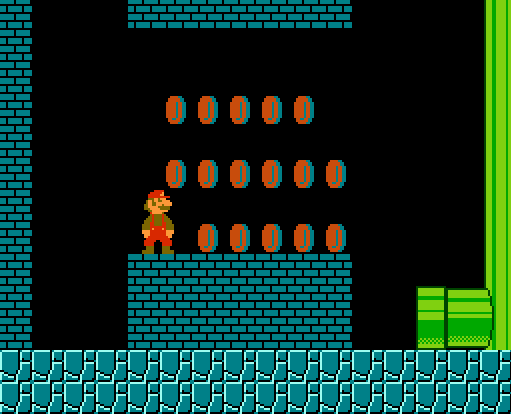
Mario's Parallel Coins

Mario.png


While playing a computer version of the classic Super Mario Bros. that I found online, I found a secret underground area, which is pictured above. In the underground area, I noticed that the coins seemed to be perfectly parallel to each other.

Parallel Coins.png


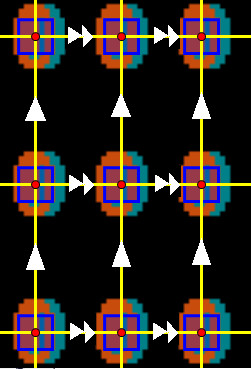
And, as it turned out, I was correct. By placing a point at the center of each coin and drawing lines between them, the coins formed lines parallel vertical lines and parallel horizontal lines. One can prove them parallel because the corresponding angles are congruent, the alternate interior angles are congruent, and the same-side interior angles are congruent. Because all of the angles formed by the intersections of the vertical and horizontal lines all have a measure of 90 degrees, they are perpendicular. This shows something important about coplanar horizontal and vertical lines: they are always perpendicular to each other. (~JC1)

Divergent. Yay.

This is my drawing of Eric from Divergent by Veronica Roth. I used a grid because I based it on another picture. I gridded the other picture, which was this guy (Gerard Way from My Chemical Romance):

My drawing also contains many sets of parallel and perpendicular lines.


(~CS1)


Geometric Window


This is a picture I took of my garage window. I noticed more than one geometry concept in it. It is an example of parallel lines, congruent angles, and perpendicular lines. I compared the lengths of each segment with the length of my phone and they are indeed equal. -(CD1)

Congruent Angles in a Stool


I noticed that a stool in my house had rungs that were parallel to each other. I figured that if the rungs were parallel then the corresponding angles would be congruent. After taking the picture and putting it into GSP, I found that angle BAF was indeed congruent to angle DCF. (~DM2)

Geometric Tiles


These tiles are an example of if two parallel lines are cut by a transversal, alternate interior angles are congruent. (~JZ5)

Monday, March 3, 2014

PS4 Angles


I saw on my PS4 that front was made up of parallel lines, congruent angles and congruent shapes. To the left there are two congruent rectangles with lines on the top and bottom that are parallel to each other and same goes for the left side except the rectangles are bigger. (~DF5)

Friday, February 21, 2014

Parallel Lines


This shows that angle ABC is congruent to angle ADE, and therefore segment BC is parallel to DE by postulate 11 -- it states that if corresponding angles are congruent when a transversal crosses two lines then those lines are parallel. (~JZ5)