Showing posts with label polygons. Show all posts

Friday, May 2, 2014

Congruent Parallelograms?

Although you may not be able to tell by the picture, these blue and yellow parallelograms are the tops of two led containers for my mechanical pencil. I traced them with help from the construct>parallel line, construct>perpendicular line, and construct>midpoint tools in The Geometer's Sketchpad.
I drew two altitudes (k and n) in order to find the height of each parallelogram. Then, I multiplied each height by its corresponding base and, to my surprise, found these parallelograms to not have equal areas, and therefore not be congruent.
The total area of parallelogram ACDF is 17.16 square centimeters.
(~GC2)

Thursday, May 1, 2014

Beijing Olympic Swimming Pool


This is the Beijing 2008 Olympic swimming pool. In the China trip we briefly saw it and I remembered that the outside of this building is a bunch of polygons put together on one giant rectangle. Unfortunately the pictures I took were bad so I found this good one.  (~DF)

Tuesday, April 1, 2014

Inscribed Angles and Three Corollaries

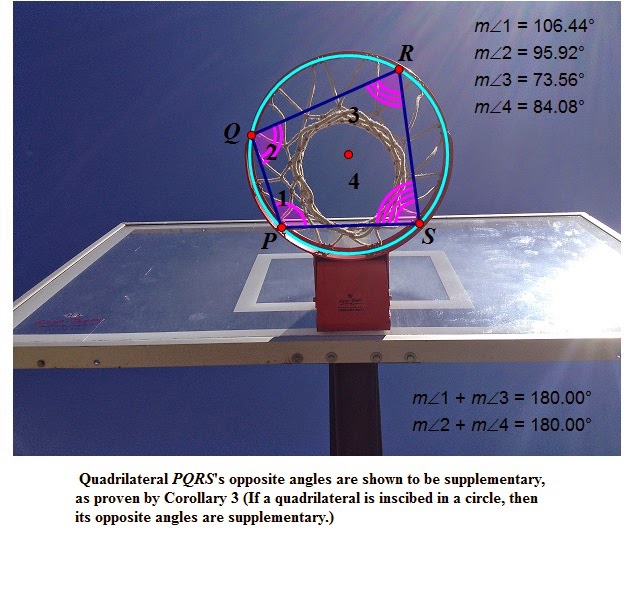
In honor of March Madness, I decided to base my Geometry Hunters post on basketball. While playing basketball at Oakwood one day, I looked up to notice the ring part of the hoop was a perfect example of a circle. I then went on to try to prove the three corollaries listed in Chapter 9 of our textbooks with this simple real-life example of a circle.

Corollary 1: If two inscribed angles intercept the same arc, then the angles are congruent.


Corollary 2:  An angle inscribed in a semicircle is a right angle.


And finally,

Corollary 3: If a quadrilateral is inscribed in a circle, then its opposite angles are supplementary. 


(~RO5)

The Circular Olive


"If a quadrilateral is inscribed in a circle, then its opposite angles are supplementary."

This corollary is clearly proven through the addition of the opposite angles of the quadrilateral I drew within this circle on GSP. (~AI5)

Rims

Here is something cool I noticed about the rims on this car.


This car's rims form a circle, which also have smaller circles inside of them. 


As you can see, there is one big circle containing five smaller circles. These circles all appear to be similar. I drew radii for all the circles aiming towards the center of the rim, and they appeared to form a pentagon.


I thought it was really cool that this car's rims contained many circles which could form other geometric objects. - (DM5)

Thursday, March 27, 2014

Regular Octogan


When I was at a hotel recently, I noticed that the table was a regular octagon. Because this picture was taken at a distance, the table is distorted. From straight on top the table would look more like this.

I wanted to find the area of the octagon.  The equation for this is (1/2)(apothem)(perimeter).  The apothem is the length from the center to the midpoint of one of the sides.

Here, segment OI is the apothem and is 4.35 cm.  Each side is 3.61 cm. The real table's sides were about 0.6m or 60cm. To find the real apothem we can set up a proportion with


This equals 72.299cm, the length of the apothem.  Then, we can find the area of the octogon


(~NW5)

Thursday, March 13, 2014

Parallel or Not?


These are bricks arranged in a pattern to create the back walls of a fireplace. I wanted to see if the lines were exactly parallel. However, the alternate interior angles are not congruent, meaning that according to my GSP diagram, the edges of the brick are not congruent. Also notice that to make this pattern, the bricks have to be exactly 2x longer than they are wide... (TF2)

Wednesday, March 12, 2014

Pentagons Within a Lotus Chandelier

I saw this giant lotus chandelier, probably about 20 feet tall, in a shop in Chinatown, San Francisco.


From the naked eye I thought I found a regular pentagon within the body of the chandelier, but I was rather disappointed to find that it is only a pentagon (not regular). All the side lengths are different, but the angles add up to 540 degrees. Since the differences in length are so minute, I can see why I assumed it a regular pentagon.  (~LU2)

Chocolates!

This is a picture of a Nestle chocolate tin container I saw at my friend's house. This demonstrates the theorem stating, "The sum of the measures of the angles of a convex polygon with n sides is (n-2)180." The chocolate tin was in the shape of an octagon, which obviously has eight sides. So the sum of the measures of the interior angles of this polygon is (8-6)180=1080 degrees. Each individual angle was 135 degrees, and 135(8)=1080. Yay! (~RG1)

Tuesday, March 11, 2014

Quilting Stars


My grandmother was a quilter, and quilts need geometric designs to fit together well. In this quilt, there are beautiful stars. Stars consist of both concave and convex angles. These stars wouldn't be considered "regular" because they are uneven in length and angle measure. The exterior angle measure of these stars would not be 360 like a regular polygon (it is actually 401.48), because of the concave and convex angles, but they sure are pretty! (~CB1)


The Interior Angle Equation of a Polygon

Here is an example of how the equation used to find the interior angle measure sum in polygons works.

Angle sum = (n-2)(180)


This is a Lamborghini that I photographed at a car show. Notice how the headlights form pentagons. Now we will test to see if the equation works.

To find the sum of the interior angles in a pentagon, the equation is (5-2)(180).

(5 - 2)(180)
= 3(180)
= 540

So, the total measure of all the angles in a pentagon equals 540 degrees. This equation should work for all pentagons, so now let's test to see if it works on the headlight.


As we can see, the measures of all the angles are: 54.56, 129.09, 103.2, 136.76, and 116.39. If we add these all together, we get 540, which proves the equation to be correct, for both regular and non-regular polygons. (~DM5)

Friday, March 7, 2014

Tessellations in a Table


I saw a table and noticed it had tessellations in it. First off, the shapes are hexagons. This can be proved using the formula (n-2)180 where n is the number of sides and the sum should be the sum of the angles. So (6-2)180= 720 degrees.

The hexagons fit together at the intersections because the two smaller angles are about 50 degrees and the two larger angles are about 130 degrees.  Altogether it is 360 degrees.  This means there are no gaps in the tessellation, and it fits together well.  (~NW5)


Thursday, February 6, 2014

Soccer Tessellations


A soccer ball is one big tessellation, which is a repeating pattern of one or more shapes that covers the plane completely without overlap.  In this instance, however, the soccer ball is a curved surface filled with regular polygons (here pentagons and hexagons).  They are able to interlock because the ball is spherical, and so it works that each side of the pentagon is attached to a hexagon. This would not work on a flat surface because the sides would not fully connect. (~KM5)

Sunday, February 2, 2014

It's a Small (Geometric) World


It's a small world! This structure is made of all kinds of different shapes, and you can find tons of concepts from Geometry in this picture. On the far left, there is a grid-like shape that demonstrates parallel lines being cut by traversals. There are lots of vertical angles, in the middle of the right side, and next to the grid on the left side. On top of the clock (in the middle), there are also two blue congruent triangles. (~CD1)