Showing posts with label circles. Show all posts

Thursday, May 8, 2014

Circumference, Area, and Pie

After taking a picture of this fruit pie (because everyone takes a picture of their food before they eat it these days) I noticed that this pie was a perfect example of a circle, and using some simple formulas, I could find its circumference and area.


After measuring a radii of the circle, I was able to calculate the area and circumference using the formulas shown above. 

But, why stop there? It also became apparent that I could inscribe a polygon inside the circle, and calculate the area of that as well. In this case, I used a trapezoid.


As shown above, I was able to calculate the area of this trapezoid using Theorem 11-5.

It's seems that everything, even a fruit pie, has some relation to math, and more specifically: geometry. 

-RO5


Wednesday, May 7, 2014

Geometry in an Old Sailing Ship


This picture shows an example of perpendicular lines in the ship's sail and mast. There are also examples of an isosceles triangle in the ropes on top. In the middle, there is a crows nest that shows an example of a circle, with the mast going through its center. (~CD1)

Friday, May 2, 2014

Decorative Segment

 I was walking through my living room when suddenly I saw a Chinese style decorative plate and it happened to remind me of our latest chapter of geometry. I decided to show how to find the area of a segment.


As you can see, I went in GSP and drew what it would look like. I drew two radii, which happened to form a 120 degree angle. Area is pi radius squared, so I divided it by three because the circle was cut into three equal sections. Then I calculated the area of the triangle with the Pythagorean Theorem and subtracted the whole section from the area of the triangle. (~WM5)

Tangent Coins


Here are two ordinary coins, a quarter and a nickel. I am going to draw an external tangent from the quarter to the dime. I will be showing how drawing a line from the center of one of the coins (or circles in this case) to the point of tangency will form a right angle.


It is clear that the angle drawn from the center of the dime to its point of tangency (on the tangent shared with the quarter) is roughly 90 degrees, thus proving that any line drawn from the center to a point of tangency creates a 90 degree angle.


It is also seen here that the line from the point of tangency to the center creates a 90 degree angle.

(~DM5)

Hamster Wheel


I was feeding my hamster and noticed the wheel that she runs on. On the wheel are two steel segments that are running through the circle. These segments are both congruent and are both the diameter of the wheel. Since the chords of the circle (the diameter) are congruent this displays Theorem 9-4, which is that congruent chords have congruent arcs. Both the arcs share the same central angle which also prove that the arcs would be congruent. (~AV5)

Baskets and Circles

I saw this basket that was holding oranges in my house and realized that it had an interesting design on it. The diameter is splitting the circle in half creating two congruent arcs. The other two chords in the circle share the same central angle. This means that the arcs would be congruent based off theorem 9-3, which is that if arcs share central angles then they are congruent. the chords would also be congruent because congruent arcs have congruent chords. (~KM5)

Drum Segment

In this picture of a drum head, I demonstrated how to find the segment.  First you find the area of the sector that you are dealing with, then you figure out what the area of the triangle is & subtract the area of the triangle from the sector area.  What is left should be the segment area. (~JG2)

Congruent Segments and Arcs

This is a semi-circle window that is in the front of my house. In this window the 3 segments CF, DF, and BF are congruent through the one central angle to the edge of the arc. Also in this picture the 4  angles coming out of the center point F are congruent to each other because of their congruent arcs and central angle. Note: the measurements are not exactly congruent because the point is not in the exact center of the window. (~AD1)

Wednesday, April 30, 2014

Home Decorating


My mom wanted to buy fabric to cover our semicircle window, and she wanted to know how many feet of the fabric to buy, and how much adhesive she needed in order to put it up. In order to find the area, I used ½(3.14)(30^2), which ended up to be 1413.71 in, or about 118 ft. Consequently, I told my mom to buy around 150 ft of fabric, in order to have enough. Next, I found half of the circle's circumference, plus the diameter, which ended up in resulting in 154.25 in, or about 12.85 feet.
(~KR2)

Friday, April 25, 2014

Bent Shower Rod

This past week I went to Monterrey with my mom for a little vacation. We stayed in a small hotel and while there I noticed the bent shape of the shower rod. I immediately thought of geometry.


After drawing in a straight bar and calculating the area of the triangle formed versus the increased area with a bent shower rod:


I concluded that the bent rod greatly increases the space within the shower.
37.31-21.63= 15.68 cm-squared more space.

This is probably one of the simplest yet one of the most useful inventions for everyday life. (~LU2)


Sunday, April 20, 2014

Weave of a Rattan Chair

I saw this chair in my house and I noticed that the backrest is a tessellation.


After zooming into the weave pattern I realized that the pattern was made up of triangles and circles. Ideally, all of the triangles should have the same side lengths and angle measures, but this is not true because the width of each rattan strip is not the same. (~LSU2)

Wednesday, April 2, 2014

Congruent Circles

I remembered how in class we talked about how six congruent circles could perfectly encompass another congruent circle in the middle and I wanted to see it my self. Here it is with the measurements to prove they are congruent. (DF5)

Angles and Arcs in Clocks


In this picture angle EJF equals 135.15 and is congruent to its arc EF which equals 135.19. This is because a central angle inscribed in a circle is congruent to its arc.

[Note: The numbers are slightly off though because the angle is not exactly in the center of the clock. This makes the numbers not perfectly equal but if the angle was in the center the angle and the arc would be congruent.]

 (~AD1)

Proving Theorem 9-5 with a Car Tire

As theorem 9-5 states, "a diameter that is perpendicular to a chord bisects the chord and its arc." I decided to use a picture of my car tire to show the proof of this theorem. 


~ (JC2)

Geometrii


When I walked by my TV, I noticed this Wii remote wheel. I then wanted to test out the theorem that states that the product of one secant segment and its external segment equals the product of the other secant segment and its external segment. I soon found that the theorem holds true, and the products of the lengths were equal. ~(DM2)

Common Tangents


After finding these materials in my room, I noticed that I was staring at a circles that had both internal and external common tangents. You could see both of the ways that made this true. The top picture shows that the two circles could share an internal common tangent, and the second picture below shows the circles with common external tangents. (~MC2)

Tuesday, April 1, 2014

The Truth About Circles


This illustration demonstrates that when you multiply the whole secant by the section outside of the circle, its product is congruent to the other secant multiplied by the other section outside the circle. (~MM2)

Arcs and Central Angles


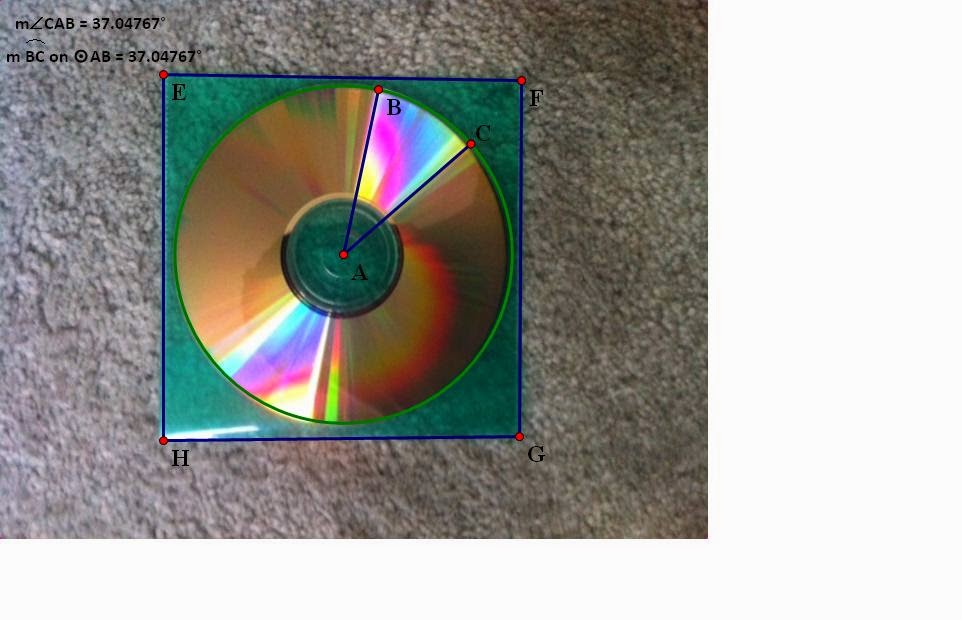
This picture is of a CD disk in its cover. This picture shows two different ideas. One idea is a quadrilateral circumscribed about a circle. The cover fits around the disk like a quadrilateral circumscribed about a circle. The second idea is arcs and central angles. Point A is the center point here. Arc BC is approximately 37 degrees. The central angle CAB is also 37 degrees.

Inscribed Angles and Three Corollaries

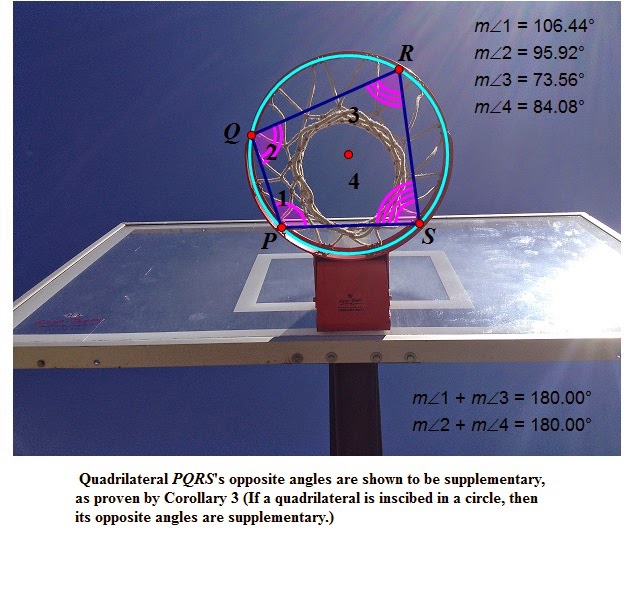
In honor of March Madness, I decided to base my Geometry Hunters post on basketball. While playing basketball at Oakwood one day, I looked up to notice the ring part of the hoop was a perfect example of a circle. I then went on to try to prove the three corollaries listed in Chapter 9 of our textbooks with this simple real-life example of a circle.

Corollary 1: If two inscribed angles intercept the same arc, then the angles are congruent.


Corollary 2:  An angle inscribed in a semicircle is a right angle.


And finally,

Corollary 3: If a quadrilateral is inscribed in a circle, then its opposite angles are supplementary. 


(~RO5)

Concentric Circles


While going through my bookshelf I noticed that one of my books had an interesting design on it. These circles that are known as Concentric Circles. They all lie in the same plane and have the same center. Also the lines going through the circles are called secants. (~AV5)