Friday, February 21, 2014

Floor Tessellation: Dealing with Similar Triangles


This image shows the tile pattern on a floor, a collection of similar triangles. This assortment of triangles connects with the AA Postulate, which can be seen by looking at two small triangles. Now, since they coincide perfectly for this tessellation, you can see that the angles are congruent to each other. Since two angles are congruent, then the triangles are similar by the AA postulate.

Now take two small triangles that have connecting vertices that form vertical angles. By the SAS Similarity Theorem, these triangles have one congruent side, congruent angles (vertical), and then another pair of congruent sides. On the other hand, they also demonstrate the SSS Similarity Theorem, because all sides are proportional.

The Triangle Proportionality Theorem is also evident if you look at a larger triangle made of four smaller triangles. A line in the middle that intersects through both sides of the larger triangle is parallel to the base, which divides the sides proportionally.

The Triangle Bisector Theorem can lastly be demonstrated. If you bisect any given triangle with a ray, then it will divide the opposite side into segments proportional to the other two sides.

Overall, many theorems can be applied to this design (~JG2)

Thursday, February 6, 2014

Soccer Tessellations


A soccer ball is one big tessellation, which is a repeating pattern of one or more shapes that covers the plane completely without overlap.  In this instance, however, the soccer ball is a curved surface filled with regular polygons (here pentagons and hexagons).  They are able to interlock because the ball is spherical, and so it works that each side of the pentagon is attached to a hexagon. This would not work on a flat surface because the sides would not fully connect. (~KM5)

Structural Vertical Angles


Vertical Angles: Two angles whose sides form two pairs of opposite rays.
Theorem 2-3: Vertical angles are congruent.

In this situation, with the beams under the overhang, angles VUW and XUY are congruent by theorem 2-3, and it is also proven through the angle measurements given by GSP. (~AI5)

Parallel Bricks


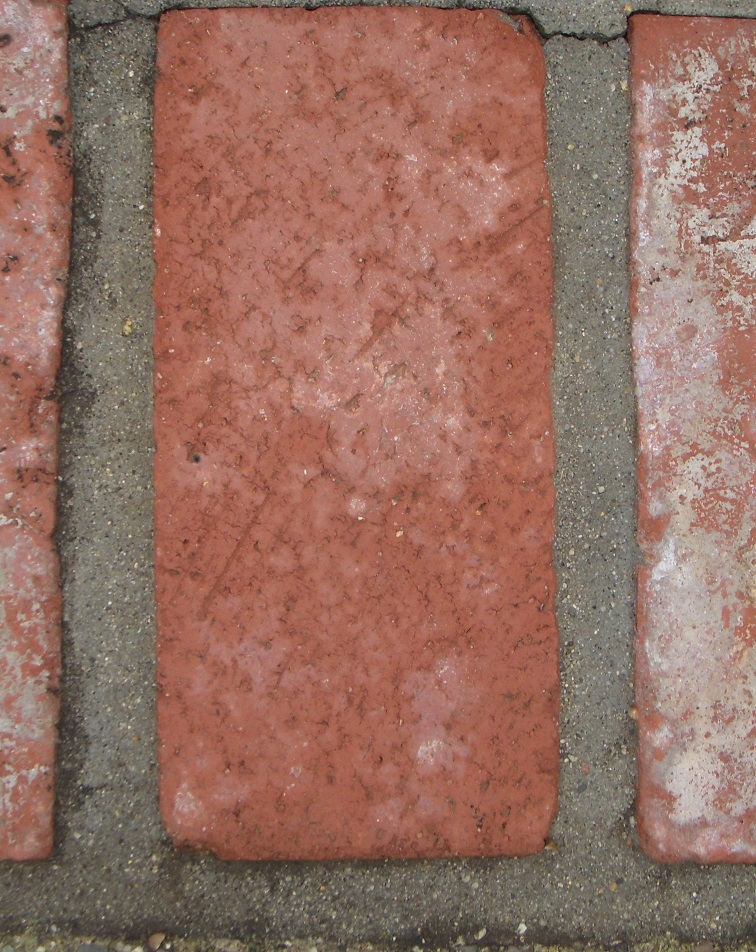
These bricks demonstrate rectangles and, by definition, parallel lines. In fact, they demonstrate many of the postulates and theorems about parallel lines.


A rectangle is a special type of quadrilateral with opposite sides parallel and consecutive sides perpendicular. Because the consecutive sides are perpendicular, each consecutive angle must be a right angle and the opposite sides must be parallel because the same-side interior angles are supplementary. Each bricks is also parallel to the two next it, as shown above. (~JC1)

Parallel Lines and Bar Codes


The bar code on this eraser demonstrates Theorem 3-7, which states that in a plane two lines perpendicular to the same line are parallel.


Lines j and k are both in plane z, and they are both perpendicular to segment AB. Since they are both perpendicular to segment AB, the lines of the barcode are parallel. (~LSU)

Eiffel Tower with Geometry?

When you first look at the Eiffel Tower, you may not notice all of the triangles it contains. Not only does it contain triangles but also perpendicular and parallel lines.

First I would like to show you parallel lines:


The three lines shown are all parallel. They show the two base lines and the middle line of the structure. The two bottom beams support the whole structure, allowing it to be the tallest building in Paris. The middle one also allows for stability. If any of these supports were at an angle, the whole tower would fall down.

Second, I would like to show the perpendicular lines:


The perpendicular segment circled in red is one of the many perpendicular lines in that row. If you look to the right, you will see the up and down structure that I have traced: it creates 90 degree angles on all sides -- therefore it is a perpendicular line.

The third and the final photo is of the triangles:


Here I show some of the many similar triangles found in the Eiffel Tower. On the left you will find the smallest triangles found in the Eiffel Tower, and on the right I combine two of the miniature triangles to make larger triangles. There are many triangles found in this tower; you don't even have to look hard.

Now I hope you can see some of the geometry in the Eiffel Tower. Just look around and you will see many geometric figures. (~KM1)

Geometric Tiles


Tiles are often used for flooring because of the intricate patterns and tessellations that they can form. In this photo you can see examples of congruent triangles. You can tell that they are congruent because of the verticals angles and the fact that they are next to squares -- this arrangement shows the use of the SAS postulate to prove the triangles congruent. You could also use parallel lines and interior angles to use the ASA postulate. (~AL1)